Tuesday, September 11, 2012

Thoughts on E-Publishing

The author, both glorified and ignored throughout literary history, has not been unaffected by the wake of the Digital Revolution. With the development of free and collaborative writing forms such as blogs, fan-fiction sites, and digital self-publishing, the relationship between today’s original author and his original work is not the same as the kind of relationship Arthur C. Clarke might have had with his 2001: A Space Odyssey. In the year 2012, we might reflect upon Clarke’s words with a little more cynicism: “Any sufficiently advanced technology is indistinguishable from magic,” he says; but is it black magic? Regarding the advent of e-readers, the biggest change to reading to since the Gutenberg press, most authors seem to think so.  The Digital Age and all of its technologies are revolutionizing the ways in which writers must interact with the rest of the world; the question is: is this good magic or bad?

As a hopeful novice in the world of publishing, I face every article regarding the “rise of the e-reader” and the “decay of publishing” not without a certain degree of terror. I ask myself if the world I have only just discovered is already beginning to implode; I am quickly reassured. Publishing isn’t dying (book sales are, in fact, increasing!) but evolving into something new and more fluid than perhaps it has ever been. While I do not see myself writing a novel in the foreseeable future, I do see myself working alongside writers, but I wonder what role they must play in this new, fluid world.


Monday, July 2, 2012

James Tate

Where I work at the library, one of my jobs is picking up discarded books, logging the Forgetful out of computers,discouraging people from watching porn in the back of the study areas, and making sure no one has curled up in the student cubicles to die. Today I found a small green book of poetry called Absences.

It's a collection of poems, some good and some not so good, by James Tate. He was born in Kansas City in 1943, won an award for his first book of poetry when he was 23, and taught at Iowa, Berkley, Columbia, and the University of Massachusetts.

This green book is a first edition published by Little, Brown, and Company, and is shamelessly marked in soft pencil by someone who loved someone else. "Breathing" is starred in the corner and annotated with the hasty line, "telling out story." The other poem with a dog-eared corner is called "Entries."

"Wait for Me" is one of the good poems:
A dream of life a dream of birth
a dream of moving
from one world into another

All night dismantling the synapses
unplugging the veins and arteries . . .

Hello I am a cake of soap
dissolving in a warm bath

A train with no windows and no doors
a lover with no eyes for his mask
—inside is the speed of life

Who can doubt the worth of it
each letter written is obsolete
before it finds its friend

Our life is shorter now
full of chaotic numbers
which never complete a day

It will be the same
as it has always been
and you are right to pack

your heart in ice
if you believe this.
Most of "Absences," the poem for which the rest is named, is a chunky compilation of phrases. I do like number 10. It's such simple heartache. But as soon as I finish each phrase, the clever turnabouts all but turn screws in my heart:
I was confused
then I got used to it
as I got used to whiskers.
The laugh is bitter &forced,
flat as a hungover Sunday school teacher
all beat-up by the blight
of the truth of the night before.
There, apologize, for thinking.
A pinched and brittle smile.
Throw a handful of magic
purple dust in my eyes
so I can see the last straw.
All the time I am afraid
the children from my childhood
will get me, my whistling
hot fantasy: those were great moments
in somebody's life.

I look at the ceiling,
then turn and avert my eyes,
and say exactly what is expected of me:
the days just come to me.

Why aren't you in my way?
 I can't close the book on that poem. Perhaps that is why someone left this on the high-top coffee tables by the big windows. I can't imagine anyone reading poetry in an air-conditioned room when the flowers outside are sitting in 80 degree sunshine (unless that person is being paid to sit at a desk and patrol the workstations every once in a while). #10 would solidify the cold.

I like this one. Every book of poem contains one poem about writing poetry. It must be standard, but this one is more wry than is usually called for. It's called "Teaching the Ape to Write Poems":
They didn't have much trouble
teaching the ape to write poems:
first they strapped him into the chair,
then tied the pencil around his hand
(the paper had already been nailed down).
Then Dr. Bluespire leaned over his shoulder
and whispered into his ear:
"You look like a god sitting there.
Why don't you try writing something?"
 

Saturday, June 23, 2012

Confessions of Contemporary Reading Devices

In the name of the Faulkner, and of the Seuss, and of the Holy Huxley, it has been many years since my last confession. Forgive me for I have sinned...I have been tempted by the Kindle. 

My friends and co-workers, who have been led from the path yet whom I still believe hold Print in their hearts, have long ago yielded to technological gluttony and purchased e-readers. And I have been a shadow, watching first with disdain, then sadness, and then slowly growing curiosity. I wanted to touch it, to hold it, to actually scroll through the e-ink and peruse the ephemeral digital files of my favorite stories. I found that e-readers are a type of magic. I can instantly read whatever I feel like reading, regardless of the text's existence on my physical bookshelf. I can download pdfs. I can slip into my bag and not break my back. I can find my favorite quotes and passages easily with a few finger-strokes. I can keep thousands of tombs in a rectangle slightly larger than a piece of toast. And toast is a magically convenient size.

For a moment, I wanted to purchase a Kindle.

Then I was saved by job at the library, where I sit at the help desk and peruse the interwebs and write confessionals. I found some articles about e-readers by people who held varying opinions on the topic. Andrew Croft, a well-known author and ghostwriter, maintains a blog that has proved incredibly useful to my senior thesis on digital authorship. One article, however, is blasphemous. It's called "Falling Out of Love with Physical Books." He writes of his sinful love and hate like so: 
"The book arrived and I carried it off to one of my favourite reading places, only to find that we now do not have bright enough lighting for anything which doesn’t have a back-lit screen, (a result of energy-friendly light bulbs and aging eyes). There was no facility for increasing the size of the print to compensate, which my obliging little iPad would have been happy to provide for me. When I did eventually find enough light I discovered that the print ran too close to the edge of the pages for me to be able to keep the book open without either contorting my fingers uncomfortably or cracking the spine back in a way that would once have seemed like sacrilege. With one spiteful jerk I snapped its fragile spine, immediately feeling like I’d kicked a kitten."
That's right. Books are essentially as precious as kittens, and Mr. Croft ripped one down the middle. He does bring up some excellent points about traditional books: they require enough light to actually see the print; they are often contain uncomfortably uncompromising formatting; they often do not appear on your bookshelf when you want them too (they are like cats...). In addition, books are made of paper and therefore kill trees (that's right, right?); publishers are elitist pricks who charge way too much for their slimy titles; and not every book contains a useful index if any at all. They're heavy, cumbersome, and.....

Beautiful. I cannot turn my heart away from books. With some help from that same interweb, I again saw the light, and the light did not shine too brightly upon e-readers.

With the amount of energy it takes to extract the rare metals needed to create a single kindle, it doesn't seem like e-readers are incredibly green. Several different articles have reported on "how green is an e-reader," and unfortunately it does not seem like the current e-readers defray the cost of energy it takes to make them. However, as grudgingly as I admit this, one year of e-reader usage creates less ecological damage than one year of book production9. My solution is to save the used books store, but I fear they will soon become mythical creatures.

Lev Grossman (love letter found here), lauded one giant--yet hardly recognized--foible of the e-reader: nonlinear reading. In his article for the New York Times, "From Scroll to Screen," Mr. Grossman retold the tale of the evolution of the codex, the first step towards the book as we know it. The jump from the scroll to the codex was instrumentally influenced by the desire for nonlinear reading experience. Previously, a reader had to peruse the entire scroll, slowly unwinding it, to reach a certain point in a text (perhaps where the digital term "scroll" comes from). The codex let readers flip through pages (that's a big deal, you guys), to escape the cage of linearity set down by the writer; the reader gained the power to influence her own reading experience. This ancient tale translates perfectly to the book (codex) vs. e-reader (scroll) dilemma. Mr. Grossman explains the foible of today's digital scroll-devices:
But e-books and nonlinearity don’t turn out to be very compatible. Trying to jump from place to place in a long document like a novel is painfully awkward on an e-reader, like trying to play the piano with numb fingers. You either creep through the book incrementally, page by page, or leap wildly from point to point and search term to search term.
 And then there are codexes--books--which are so well suited for nonlinearity that they have survived thousands of years of readers:
 The codex is built for nonlinear reading — not the way a Web surfer does it, aimlessly questing from document to document, but the way a deep reader does it, navigating the network of internal connections that exists within a single rich document like a novel. Indeed, the codex isn’t just another format, it’s the one for which the novel is optimized. The contemporary novel’s dense, layered language took root and grew in the codex, and it demands the kind of navigation that only the codex provides. 
So on one shoulder, I have the e-reader, kindling my desire for all the stories in the palm of my hand; on the other, I have the book, around since the dawn of time and created to satisfy my needs as a reader, one story at a time. E-readers are green-ish, compact, portable, and able to leap tall piles of material in a single bound. The book, however, my dear friend, needs no batteries, fills up an empty bookcase with the elegance only a real book can give, and in return for my love, it gives me power. It's no wonder the Christians influenced the great development of the codex (the bible, duh); books are godly.

Tuesday, May 29, 2012

A Love Letter to Lev

Dear Mr. Grossman,

I disliked The Magicians. I thought the story was too long-winded, the character dynamics trite, and the characters themselves merely detestable. I didn't want an extended version of 5th-year Harry's angst; I wanted more child-fantasy-magic godamnit. So I threw the paperback on the shelf with the equally-disappointing Wuthering Heights and went on to read something a little less unnerving.

Unnerved? How could a bad story leave me so agitated? The Shelf of Rejection begged the question every time I passed it, resulting in an annoying reversal of opinion of Heathcliff and Catherine (that's another story). I decided to give The Magicians another go.

And while I still think parts of it could be cut out or condensed...

My initial impression of charicature melted. My recent years in college have introduced me to a Penny, an Eliot, a female Josh, and sadly, an Alice; and then of course there's that bittersweet moment of realization, as I finish the story for the second time, that I am the ridiculously named Quentin Clearwater.What I wanted was exactly what I said before: simple magic, a child's fantasy. What I realized is that if magic was real, it would about as simple as real life. Your story is a refreshing, but chilly dose of medicine, and I like it.

And I really, really love the technical craft of the magic.

I haven't read The Magician King yet, but I have come to the modest conclusion that I love everything you write for Time. At the risk of sounding cliche, your words strike a chord with me. I laugh, I cry, I learn, I run to the bookstore. Who cares if you look a little like a Shakespearean Dr. Evil? There is nothing like listening to the thoughts of another booklover, especially when that booklover so apparently loves Jonathan Strange and Mr. Norrell. I trust anyone who understands how great that story is. You complicate literary conversations with beautifully wrought knots of words that seem to convey your opinions so fluidly... I'm rather envious. When talking about your own literary adventures, you're candid and insightful and, perhaps most importantly, fun. You've given me a glimmer of hope that not everyone I will encounter in the world of books looks down on fantasy through cold, thin-rimmed spectacles perched delicately on their professionally sensible noses. Books are wonderful, and it makes me glad that you think so too.

Love,
Moi

Lev Grossman; from The Jewish Daily Forward

Friday, May 25, 2012

If I'm Ever Stranded


A State of Repugnance

I love words, but my relationship with The Dictionary is often tinged with the eggy aroma of repugnance.

REPUGNANCE (Noun) 
1. the state of being repugnant. Thanks, sassy dictionary! You're so helpful.
2. a strong distaste, aversion, or objection; antipathy. 
3. contradictoriness or inconsistency. Contradictoriness is not recognized by Google as a real world. Since when does the dictionary use made-up words in their definitions! Alright, it's a real word...but it could  be made-up; that's just how dictionaries are these days.

My favorite entry for the word "repugnant": repellent to the senses. The next time I find something repugnant, I will haughtily declare it to be repellent to my senses. The dictionary redeems itself with phrases like this.

Of course, there are many other things which I find repugnant and contradictory to my senses and general well-being:

  •   OVER-STEEPED TEA.

  •  THE FOLLOWING SMELLS:
 Purell and all its knock-offs; vacuum cleaner bags after you've vacuumed up a bunch of crunched Goldfish or similarly cheesy snack; dirty sponges.  

  • NAIL POLISH THAT CHIPS SOONER THAN EXPECTED.

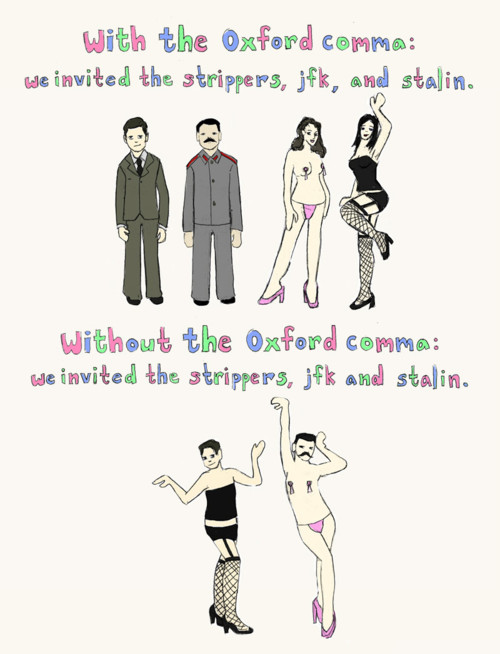
  • MISSING OXFORD COMMAS
 Technically, according to some, the Oxford comma is unnecessary. Grammatical punctuation is a set of guidelines, not necessarily rules, to make communication better. When make a shopping list, you know exactly what I mean when I write, "I am going to buy some duct tape, some rope and a shovel." There's no confusion as to what items I am referring to ( I could care less about ending sentences with prepositions...unless it sounds funny), and adding a third comma would be unnecessary. But there are many, many different uses for the comma, and because of this, sometimes the Oxford comma is very useful. I might use a comma to separate a descriptive title from the proper name: "my cousins, Kenny and David, are nuts" (though of course, if I only had two cousin (which I do), I wouldn't need that comma...). So when I make a list that includes that kind of comma, I might need to use that Oxford fellow to make my meaning clear: I told my cousins, David and Kenny (Did I only tell my cousins, or are David and Kenny my cousins?) versus I told my cousins, David, and Kenny. Sigh of relief.
Best example? We invited the strippers, JFK and Stalin.

 
 PEOPLE WHOSE OPINION OF VAMPIRES IS MERELY AN EXTRAPOLATION OF THEIR FEELINGS TOWARDS TWILIGHT.
OMG VAMPIRES!! <3 <3 <3
I read the first two of Stephanie Meyer's masterpieces, and they were fantastic. In fact, they were so insightful and complete that I felt no need to continue the rest of of the series. Right.
As far as I can tell, there are three different types of Twitwits (pronounce, "twei-twits." I don't quite remember what they call themselves...): those who are, in fact, not twitwits due to their apathy towards the series or to their ignorance of it; those who loathe anything and everything related to vampires after consuming the series; and those who love it all. I take fault with the last two types, not because I take one or other side, but because their fervor tends to infect the rest of the vampire genre. Vampires are awesome. If you haven't read Dracula, I highly recommend it for those days when even the walk to your mailbox seems to take on a Gothic atmosphere. I really enjoyed Interview with a Vampire, and Let the Right One In is one of my favorite films of all time. Even Buffy is pretty cool. Vampires play with that seductive nightmare of immortality...and they're usually pretty sexy too. Stephanie Meyer did not rain on the blood parade when she published her series, nor did she significantly contribute to the party. But one foul apple does not a rotten bushel make. It's like saying all spy movies are nonsense (false) simply because Duplicity was garbage (true). So go ahead; love Twilight and hate Twilight; but don't mess with the vamps. That's my opinion. It is not based on angst and sparkles.

  • JAMES PATTERSON.
Prince George, playing James Patterson.
James Patterson has published a little more than 100 books in a little more than 35 years, ranging from romance and thriller to middle-school  That is almost 3 books a year. Congratulations, Mr. Patterson; you have turned yourself into the book-writing equivalent of an American Cheese machine. No matter how many slices you put out, I can guarantee I will never enjoy a single one.

And your commercials are very telling, Mr. Patterson. An author who advertises his books on TV must have a certain, TV-watching audience in mind. If you thought more highly of your own works, you might advertise to a book-reading audience instead. Of course, we know exactly how you feel about your own novels. 11th Hour (a thriller) and Middle School: Get Me Out of Here must both be equally phenomenal; they share an ad.

  • WALMART'S FLOOR PLANS

  • THE I BEFORE E EXCEPT AFTER C "RULE"
Freight. Weigh. Seize. Their. Foreign. Either. Deity. Science. WEIRD.

  •  WHEN PEOPLE MISUSE IRONY
I will literally head-butt you.
Definition: the use of words to convey a meaning that is the opposite of its literal meaning;
an outcome of events contrary to what was, or might have been, expected. 
Those who have a phobia of long words have Hippopotomonstrosesquipedaliophobia. How ironic!
Those who attempt to define irony using an example which is not ironic IS ironic!
When your friend uses the same wrong example of ironic later on, it's not ironic; it's coincidence.
When you insist that you gave a correct example of ironic while talking to an English major is not ironic; it's unfortunate. 
When you also tell that English Major that your heart literally stopped when your other friend misused "irony," that English major will literally head-butt you.


Friday, April 20, 2012

Birth and Death of Books


(don't ask me with this isn't centered; I wrote this post using html.)

Dear Digital Revolution,

A book is more than a medium, a mode, an information-carrying device. A book is more than leaves of paper splattered with ink and glue. A book is a piece of art. The Gutenberg Press all but wiped out the manuscript, the closest thing to holy artifact a human being could create. Do not wipe out what we have left. Do you see this? You have caused the death of bookstores, the death of so many hollows for knowledge and imagination. Do not burn the bookstores and the libraries. Do not leave the pages rotting in your wake. Art is never obsolete. Please do not try to erase the book.

Shakespeare and Company

  (Watch this video in fullscreen; it's beautiful!)

 "I like picking up the object; I like the weight of it; I like looking at the book cover...I like the sensation of...of reading a book; and it feels like even though a lot of writers here have said, their library is their friends; they're surrounded by their friends; and I really feel that about the bookshop; and it feels that those books are your friends and your family as well." 
~Sylvia Whitman, Owner of Shakespeare and Company.

I have seen that book publications are not dwindling, that book sales are still increasing, and that's wonderful. I have yet to see any positive data about bookstores, however. Borders has closed. Amazon is winning. What does that mean for Shakespeare and Company? I think the most tragic possible outcome of the digital revolution would be the death of independent bookstores.
If there is one thing from my trip to Europe that I regret, it is missing this beautiful Parisian bookstore. There is something so warm and magical about stores like this. Even watching this video, I feel the bookshelves pulling at my heartstrings and calling to my soul. If I could fly, I would jump from this window and soar over the ocean to be with my paper friends. 

Friday, April 13, 2012

Books Are a Hard-Bound Drug


My eyes may strain,
And my fingers may stain,
But books will never hurt me.

Book Hungry: How to Find Something (SciFi) to Eat

There are only two real hungers in my life: hunger for food (I'm a self-declared foodie) and hunger for a good read. More often than not, I've got a large stash of books waiting for me to get around to them. The List of "must-reads" and "should-reads" seems to grow at an exponential rate in proportion to how much I actually have to do; the less time I have to read, the more books I wish I had the time for. When I do have the time, I almost always have a little something lined up.

I would be lying if I said I ever finished The List, but sometimes nothing on the menu looks appealing. Then what? According to Google, there are 129,864,880 unique books in the entire world (as opposed to the number of books printed, which would be something along the lines of an academic bajillion). After collecting about one billion raw records from the Library of Congress, WorldCat, and other databases, Google used countless algorithms to narrow the data down to only those records which pertained to unique tomes (approximately 210 million entries); once all the microforms, audio recordings, maps, videos, t-shirts, and other strange things with IBSNs were discarded, the estimate dropped to a manageable 146 million; finally ,after the 16 million government documents were taken out of the count, Google narrowed the estimate to a mere 130 million. Of course, hundreds of thousands of new books are published every year.

Now, imagine you are hungry; not full-frontal starvation, but a niggling emptiness is begging to be filled with something delicious, something really satisfying. Now imagine you are presented with a menu that contains 129,864,880 unique meals. You would starve to death before you finished reading all the names of the options let alone the descriptions of what they actually are. You can't just settle for the first thing you know you won't hate; but how do you pick?

You could ask the waitstaff. One of the reasons The List gets so long is that books seems to be constant topic of conversation among my friends and family. Bookworms may spend a lot of their time reading, but they also seem to spend a lot of their time talking about reading as well.

My father introduced me to science fiction when I was very young, and it has since become a staple on the menu. For me, sci-fi is on par with Indian food; it's more exotic than comfort food, but it's something I always know I'll enjoy. My father will start talking about a story mentioned in some Scientific American review, found in his basement collection, or more recently, published in a copy of Asimov's Science Fiction; that story will naturally remind him of another story he really enjoyed; he'll highly recommend that I put in on his list; and the next thing I know, he's ordered a copy for me off Alibris. If you give my father a short story, he'll want an anthology to go with it...

A map of my father's literary mind might look something like this:
"A Guide to NPR's Top 100 Science Fiction and Fantasy Books." Dad also likes NPR. As an indecisive and hungry reader, you start out at the divide between Science Fiction and Fantasy. "But wait!" you say. "Those aren't mutually exclusive categories," you say, "How narrow-minded of NPR!" Fortunately, you've got options. Such open-minded and perhaps indecisive readers may journey down the path of "Can't I have both?" The more-visually minded (I refuse to call them illiterate) may choose "I only read books with pictures" (they have two options: Watchman or Sandman). The, er, disturbed may prefer horror; they get to choose between vampires or zombies. Then, of course, there are those who would "rather not be seen in that area of the bookshop." How strange. Those poor fools actually get a lovely range of "soft"- and "literary"-scifi-fantasy, from Vonnegut to Atwood to Huxley to Orwell. They don't even know.

The rest of the guide is for those who wear elf-ears and/or carry ray-guns with pride. From the basic choice, the flowchart asks all kinds of questions in hopes of determining what kind of story you're craving. The menu is quite extensive, covering everything from The Mists of Avalon and The Chronicles of Amber to A Canticle for Lebowitz and The Hitchhiker's Guide to the Galaxy (all these are on my List). Let's try this out. To get to one of my favorite fantasy tomes, Susanna Clarke's Jonathan Strange and Mr. Norrell, I must travel down the following string of queries:
  • Where should I start? Fantasy. I pretty much live in a fantasy land already.
  • Are you going to be upset when you don't find Harry Potter? No. I know where to find him if I need him.
  • Are you new to the fantasy genre? No. I'm what you call, experienced.
  • Like the Arthurian legend? No.
  • Looking for modern-day settings? No. Let's find another world, this one's depressing.
  • Fan of Westerns? No. Too dusty. And I'm not much of a card player.
  • Animals more your thing? No. I have allergies.
  • How about some alternate history? Yes. I'm a revisionist myself.
  • Romance or warring magicians? Magicians.
And voila! A lovely little snapshot of a lovely 782 page masterpiece. 
 
I find this flowchart particularly interesting because a) how on earth did the creators come up with such insightful and entertaining questions? and b) collectively, the SciFi-Fantasy genre is one crazy motley crew. How are the R.O.U.S.s in The Princess Bride connected to King Arthur? How is Frankenstein's monster related to the Martians of Stranger in a Strange Land? Some clever folks illustrated the "History of Science Fiction," and while it may look more like an alien brain than a family tree, the flowing membranes of sub-genre seem to accurately reflect how convoluted and mutated glory of Science Fiction. 
 
Originally born out of "Fear and Wonder," SciFi soon gave birth to the Utopian novel, the Gothic novel, fantasy adventure, historical romance, horror, space odysseys, Dystopias, robot philosophy, space operas, new space operas, cyberpunk, zombie battles... all from fear and wonder. It's incredible.

Knowing how Kafka fits into the evolution of SciFi, however, won't help me decide what to read. Perhaps I should just wander around the library and see what I find. After a couple of hours, I always leave with a treat....and about a dozen more books to save for later.


Thursday, February 9, 2012

Thoughts On A Hypertext Menu

The combination of the various forms of art (textual, visual, audio, performative, etc.) is not new to the literary world. Graphic novels, although long contested as being forms of literature, are now regarded as being literary works that successfully combine the power of words with the power of illustration. Audiobooks, while to my knowledge not necessarily regarded as literary bodies themselves (I've yet to hear of a work that is strictly published in audio-format), allow for the seamless combination of text and music or sound-effects, additions impossible in the print-novel-format. Electronic literature seems to be able to combine all forms of expression in one cohesive body of work.
Also by Pullinger: Inanimate Alice
The ability to create narratives in this format, however, seems to require a greater level of creativity and ingenuity (as well as flexibility). While many hypertexts are presented in a linear format--the reader interacts with the work along a linear path set by the creator (such as Kate Pullinger's Flight Paths)--others are presented in a free-for-all format (such as Olia Lialina's My Boyfriend Came Back from the War).

I see the various types of hypertext as being akin to different types of menus, with the creator as the chef and the reader as the one enjoying the delicious meal. The chef has created a 20-course meal (or however many meals..it doesn't matter), which each plate being an element of the narrative. In the linear format, the reader enjoys each course in the order set down by the chef. The chef can tailor each course to compliment the ones previous or following, creating a certain cohesion between the elements. This is found in the traditional, linear forms of literature. The other type of menu is like a buffet. The chef has put all the plates on one table, and the reader is given the choice of which courses to try first; the reader can interact with the elements of the narrative in whichever order they'd like. The chef must then be very aware of how each element interacts with the others. The author, the artist, the designer must anticipate the interplay of the reader and the text without putting themselves in the equation. If the author makes the choice to create a buffet for their readers, they must account for their lack of control. If this course goes before this course, will the cohesion of the meal remain intact? If this element is left to the very end, will the narrative still flow? Will it make sense? What happens if they eat dessert first and the fish plate last?

Saturday, January 7, 2012

Why Don't We All Just Get Along?


Both paper books and e-books have their own advantages and disadvantages. While I will always enjoy a hardcover more than a Kindle, this is a world in which both can exist in harmony. We just need to make e-books better. We need to books of all sorts perfect. I highly doubt books will ever disappear from our world, so why not work on perfecting both mediums?

Thank you, Newsweek/The Daily Beast.

Friday, January 6, 2012

THE GIRL WITH THE DRAGON TATTOO by Stieg Larsson


For a very long time (and by a very long time, I mean from the time I first heard about the Millenium series until a couple of days ago), I routinely referred to Steig Larsson's book(s) as The Girl Who Kicked the Fire Dragon, or The Girl Who Played in the Dragon's Nest, or some other plausible rearrangement of the title phrases.

Then, when the American film version of the first novel came out, my father (who had been lauding this series for quite a while now) gave me an ultimatum. Either I read the first novel of this wildly popular series before the weekend was up, or I stay at home while the rest of my family takes a little trip to the cinema. I devoured the novel.

The Girl with the Dragon Tattoo.

That is the title of the novel that left me feeling cold in the daytime, tense in the nighttime, and terribly alone at 2AM, when I'd start from a deep sleep, my subconscious having convinced itself of having solved the mystery. The next night, I stayed up way past two, knowing full well that if I didn't get to the end of the book, I would never fall asleep.

After being convicted of libel (a shady case in its own right), the middle-aged and currently downtrodden journalist, Mikael Blomkvist, is hired by Henrik Vanger to ghost-write a detailed history of the Vanger dynasty. Blomkvist soon learns that the prestigious family behind the Vanger Corporation is anything by functional. In fact, I think it's safe to assume there's a “dreadful, dysfunctional, and disturbed” gene permanently etched in their DNA. Henrik, patriarch of the clan, hates all of them. He's also convinced one of them is a murderer. Henrik's real mission is to solve the forty-year-old disappearance of Harriet Vanger. Harriet, however, is not the girl with the dragon tattoo. That badass is Lisbeth Salander. Lisbeth is a investigative security specialist with an incredible memory and penchant for revenge. She has a lot of issues; she's led a rough life. In trying to unravel the mystery of Harriet, Mikael and Lisbeth discover far more than skeletons in closets. They find murder.

Larsson's novel is not dissimilar to a police report in its level of detail. There are moments in which the range of detail is a little too much; I could care less what Mikael had for lunch, and I certainly don't need to read the exact wording of his personal emails. I would argue, however, Larsson's range of detail is, for the most part, brilliant. While it does mean you are obligated to sort through which members of the Vanger family are relevant to the mystery and which are simply miserable pricks, it also means that you will be subjected to an agonizingly slow yet steady rise in tension. The eventual relief of such anticipation arrives in two forms: sudden, twisted realizations and awful, awful nightmare.

That sounds horrible. That sounds stressful. That sounds like exactly what a mystery-thriller should be, a twisted power game between you and the author that only leaves you wanting more.


Old Book Smell